A lot of parents are feeling it.
Children can swipe before they can tie. They can find a video faster than they can open a stubborn glue cap. They can tap through a game, but struggle to cut a straight line, thread a bead, twist wire, fold paper, or figure out why two pieces will not stay together.
That does not mean children are lazy. It means childhood has changed.
So much of a child’s day now happens on smooth glass. Tap. Swipe. Scroll. Watch. Repeat. Those movements are easy, fast, and rewarding, but they do not ask much from the hands. They do not ask a child to pinch, grip, press, balance, pull, knot, stitch, squeeze, smooth, fold, or try again when something falls apart.
That is where crafts matter.
Fine motor skills crafts for kids give children something real to do with their hands. A pile of paper becomes a garland. A stick becomes a wand. A rock becomes a painted ladybug, a flag, a tiny house, or a treasure for the garden path. Felt, yarn, clay, cardboard, leaves, beads, shells, and paint all ask children to slow down and work with the real world.
The real world is lumpy. Glue takes time. Paint smears. Yarn tangles. Paper tears if you pull too hard.
That is part of the lesson.
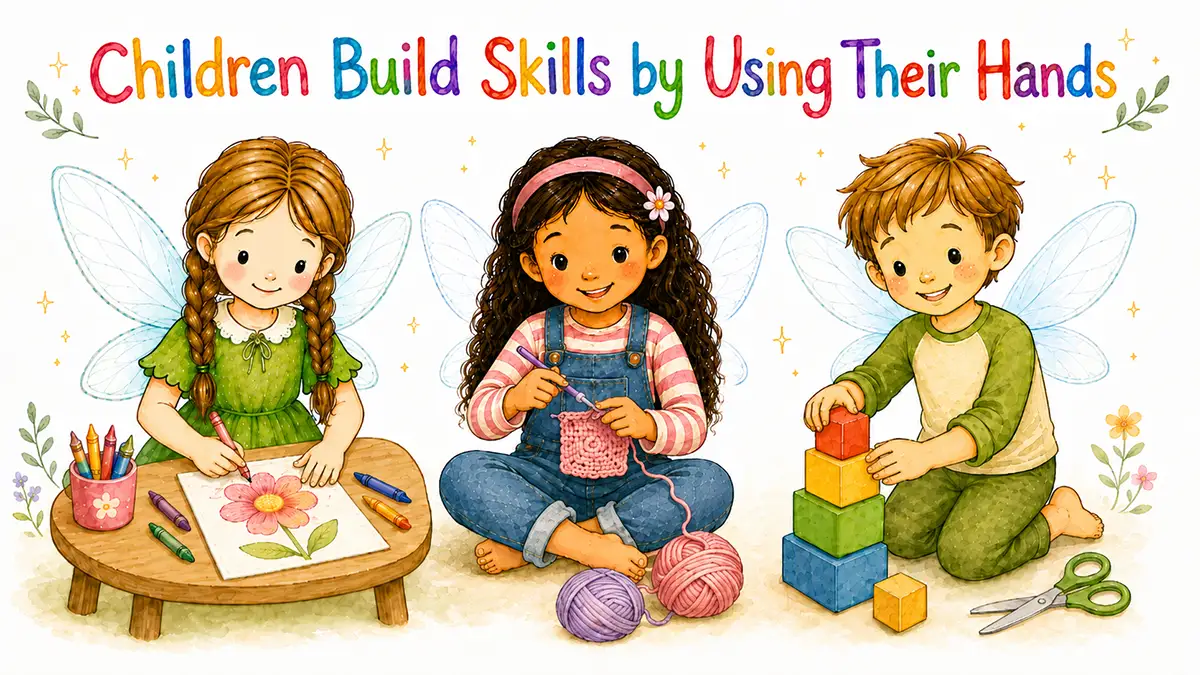
Children Build Skill by Using Their Hands
Fine motor skills are the small hand and finger movements children use for everyday life. These are the skills behind writing, drawing, buttoning clothes, zipping jackets, tying shoes, opening containers, using scissors, handling utensils, building with small pieces, and eventually doing more complex tasks with confidence.
Crafts are one of the easiest ways to practice these skills without making it feel like practice.
When a child cuts paper, they are building hand strength and coordination. When they thread beads, they are learning control and patience. When they paint a small wooden shape, they are learning how much pressure to use. When they sew a simple felt flag, they are learning rhythm, planning, and how to move carefully through a task.
Crafts also build hand-eye coordination, the skill children use when their eyes guide their hands through a task. When a child cuts along a line, threads a bead, paints a small shape, folds paper, places a sticker, or pushes a needle through felt, they are practicing how to look, aim, adjust, and move with control. These little movements matter. They help children with writing, drawing, sports, dressing, building, eating, and all the ordinary tasks that require the eyes and hands to work together.
These simple hands-on activities for kids do more than keep children busy. They build the small muscles and careful movements children need for writing, dressing, drawing, building, and everyday independence.
A worksheet can ask a child to trace a line.
A craft asks them to choose the line, cut it, decorate it, fix it, and decide what it becomes.
That difference matters.
Troubleshooting Is a Childhood Skill Too
One of the most useful benefits of crafting is that things go wrong.
The feather will not stick. The cardboard bends. The knot slips loose. The flower is too heavy for the crown. The paper star is crooked. The mobile leans to one side. The paint color turns muddy because everything got mixed together in the same cup.
These moments can be frustrating, but they are also where children learn to troubleshoot.
Troubleshooting means noticing a problem, trying a solution, and adjusting when the first idea does not work. Children need that skill everywhere, not only at the craft table. They need it when building friendships, doing schoolwork, packing a backpack, cleaning a room, learning an instrument, helping in the kitchen, or figuring out why the bike chain came off again.
That is why crafts are some of the best problem-solving activities for kids. A craft gives them a safe little problem.
The stakes are low. The lesson is useful.
If the glue does not hold, try tape, a clothespin, or a smaller piece. If the tower falls, make the base wider. If the yarn tangles, slow down and loosen one loop at a time. If the design looks strange, add more color, cut a new shape, or turn it into something else.
Children start to learn a useful truth: a problem is not always a stop sign. Sometimes it is just the next step.
Creativity Needs Materials, Not Just Ideas
Children are naturally creative, but creativity grows when they have materials to push against.
A blank screen can offer endless choices, but endless choices can make children passive. They watch what someone else made. They copy what someone else did. They wait for the next suggestion.
A small basket of craft supplies works differently.
Here is some yarn. Some cardboard. A few leaves from the walk. A paper bag. A stubby pencil. Three buttons. A little glue.
Now the child has to decide.
What can this become?
That question is powerful. It helps children imagine, plan, test, and make. They learn that creativity is not only drawing something beautiful. It can be building a tiny house from a paper bag, making a nature crown from backyard leaves, turning a cardboard box into a town, or painting rocks for the porch steps.
These kinds of creative activities for kids give children a place to practice having ideas and following them through.
Not every project needs to be pretty. Not every project needs to be saved forever. Some crafts are experiments. Some are gifts. Some are story props. Some sit on the windowsill for a week and then quietly disappear into the recycling bin.
The making still counted.
Handwork Builds Patience in a Fast World
A lot of childhood now moves at the speed of a tap.
Videos start instantly. Games reward instantly. Search gives answers instantly. That kind of speed can be useful, but children also need experiences that take a little longer.
Crafts create a different rhythm.
Glue has to dry. Paint needs a second coat. Pressed flowers need days under a book. Natural dye has to soak. Clay has to be shaped before it becomes anything recognizable. A woven stick frame takes one strand at a time.
This slower pace helps children learn to stay with something.
That does not mean every craft needs to last an hour. For younger kids, ten good minutes of focused making can be plenty. The point is not to force a long project. The point is to give children regular chances to begin, continue, and finish something with their own hands.
There is pride in that.
A child can point to the garland, the bookmark, the puppet, or the painted rock and say, “I made that.”
That sentence carries weight.
Crafts Help Children Feel Capable
Children need to experience themselves as capable people.
Not perfect. Capable.
A finished craft gives them visible proof. They made a thing that did not exist before. They chose the colors. They solved the problem. They stuck with it when the ribbon would not thread through the hole. They tried again when the first paper flower ripped.
This kind of confidence is different from being praised for being smart or talented. It comes from doing.
That is one reason why crafts are important for kids. The crooked stitches, uneven paint, giant glue dot, and wild color choices are evidence of a child making decisions.
A child who makes things learns, little by little, “My hands can do things. My ideas can become real. I can fix problems. I can try again.”
That is not small.
Simple Crafts Are Enough
Parents do not need a perfect craft closet. Children do not need a complicated setup. You do not need to turn your kitchen into a summer camp supply room.
Start small.
Keep a basket with a few basics: paper, scissors, glue, crayons, yarn, tape, cardboard scraps, stickers, and maybe a few nature finds from walks. Add seasonal materials when they show up, like autumn leaves, pinecones, shells, flowers, seed pods, or smooth rocks.
Then choose one simple project.
Make paper stars. Paint rocks. Thread beads. Fold paper boats. Build a cardboard house. Make a nature collage. Press flowers in a book. Sew two felt shapes together. Tie shells to a piece of driftwood. Paint with watercolors outside.
The best craft is often the one you can start without making the afternoon feel heavy.
A Helpful Way to Set Up Craft Time
A little structure helps children stay with a project longer.
Put the supplies in a tray or small bowls so everything is easy to see. Offer two or three choices instead of every supply in the house. For younger children, pre-cut shapes or make one simple example. For older children, invite them to plan their design, add details, or make a set.
Try saying:
“Here are the supplies. You can make a bookmark, a little house, or anything else you think these could become.”
That kind of invitation gives children direction without taking over.
The adult does not need to rescue every mistake. Sometimes the most helpful thing to say is, “What could we try next?”
Then wait.
That waiting can feel awkward, like standing by the toaster before it pops, but it gives the child room to think.
Screen-Free Does Not Have to Mean Screen-Never
This is not about making parents feel guilty.
Screens are part of modern family life. Children use them for school, entertainment, communication, and sometimes for a much-needed pause while dinner gets made. The goal is not to panic over every minute of screen time.
The goal is balance.
Children need time with stories, music, nature, family, movement, boredom, and materials they can touch. They need to build with their hands, not only consume with their eyes. They need space to make choices that are slower, messier, and more physical than tapping a button.
That is why screen-free activities for kids still matter.
Crafts offer that space.
They bring children back into their bodies. They use the hands, the eyes, the imagination, and the part of the mind that says, “Let me figure this out.”
What Children Learn From Making Things
When children craft, they are learning more than the project in front of them.
They are learning how to start.
They are learning how to follow steps.
They are learning how to make choices.
They are learning what happens when materials behave differently than expected.
They are learning that mistakes can become part of the design.
They are learning that effort can turn into something they can hold.
Those lessons do not need to be announced. You do not need to turn every craft into a lecture. Often, the best thing you can do is set out the materials, stay nearby, and let the child work.
A kitchen table with paper scraps and glue can teach more than it seems.
A Small Handmade Childhood Still Matters
Children do not need a childhood without technology. They need a childhood that still includes the real, touchable world.
They need dirt under their nails sometimes. Paint on their fingers. Yarn wrapped around a stick. A cardboard box that becomes a town. A handmade card tucked into an envelope. A painted rock left on a porch step. A crooked garland hanging across a doorway.
These small handmade things help children build the skills they will carry into bigger things later.
At Fairy Marketplace, we believe crafts are more than cute afternoon activities. They are a way for children to practice using their hands, solving problems, making choices, and seeing themselves as capable creators.
Start with one simple project.
Let it be imperfect.
Let the child make something real.
Get the free Fairy Marketplace Craft Book
14 beautiful one-page craft tutorials, from nature weaving to cardboard box towns. Plus our favorite new craft ideas and free printables a few times a season.
No spam, ever. Unsubscribe any time.
Check your inbox! Your craft book is on the way. (Give it a few minutes, and peek in the spam folder just in case.)